
180 Studios, The Strand. Until 26 July.
In 2026, attention is measured in seconds. Everything gets built for the scroll. Romain Gavras and Surkin’s collaborative project, GENER8ION, has gone the other way: music videos six minutes or longer, an album you have to walk through an exhibition to see, nothing shortened or sharpened for anyone's feed. It could have sunk without trace, but instead has become one of the most talked-about pieces of work this year, which suggests something worth paying attention to. Art that refuses to cater to the new norms can end up earning more attention than art built to chase it.
GENER8ION’S first full-length project, Love & Tears, came out on 12 June, and the same day Visions of 2034 opened at 180 Studios, playing the record back at you across a series of rooms. Seven short films, each built around a track, set in Leeds, Mumbai, Idaho, Athens, Hangzhou and LA. Alongside them, older Gavras videos for M.I.A. and Jamie xx. It closes on 26 July.
Gavras has said the year was picked at random. He wanted a near future close enough that we'd still recognise ourselves in it, and the question he and Surkin started from wasn't robots or chrome but what the kids will be doing in ten years, and what drugs they'll be taking. Speaking to The Vinyl Factory, Surkin described the results as small cultural dissonances, and Gavras talked about building a cartography of the near future. You're handed fragments, not a plot, and left to piece the map together yourself. Which is the right call, because what lands hardest is what hasn't changed.
You walk down into Neo Surf, one of the most impactful pieces in the building. An abandoned quarry outside Athens, a city made uninhabitable by toxic algae blooms, 070 Shake acting and singing her way through it. The version here runs much longer than the 2021 release, with shots you haven't seen. The marble that once built Athens has come back to destroy it. The quarry is poison and the kids are in there anyway, having turned somewhere actively bad for them into a playground. Connection and play over their own health, and they've decided that's a fair trade. Birds in the sky next to delivery drones dropping off weapons like Amazon parcels, and nobody in frame seems bothered. Gavras shoots it wide, and the scale makes that choice look small and human against a landscape that couldn't care less. He has this ability to make you want to stare closer while questioning how comfortable you are doing it, and this is where I felt it most.
Two older Gavras videos sit alongside the new work. M.I.A.'s "Born Free" is still the most politically charged thing in the building, soldiers rounding up reds and running them into a minefield, and sixteen years on it hasn't softened at all. Jamie xx's "Gosh" still looks like nothing else. Neither feels like filler, because both hold the same line as everything around them: kids, rebellion, a world already gone wrong. 2034 didn't invent any of this. Gavras has been filming it since 2010.
Elsewhere there's God Hates Space, the album opener. Gavras has said it's not flat earthers but hollow earthers, and the video is basically their propaganda. Set in the Idaho woods, full of disillusioned kids and drifters who've decided the earth is hollow and built their lives around it. Internet-age paranoia played completely straight. Nobody winks, which is why it works. The lover 070 Shake sings to isn't a person, it's the movement, which reframes the whole track. Possibly her at her melodic best, a tender vocal over a belief system that makes no sense, Surkin going enormous underneath.
The Charlize Theron piece, shot five years ago and unseen until now, is the title track Love & Tears with Yannis Philippakis. Surkin's soundscapes across the show are properly heavy, and this one almost felt like respite, which is strange to say about the most disturbing thing in the building. The premise is an emotion capture device, the kind used to let AI recreate actors, a machine trying to perfectly replicate human feeling. And here's the thing. I knew it was Theron, knew it had been shot, knew there's no render in it. But her performance is so intoxicating that I still found myself questioning whether I was looking at an AI version of her face, and once that doubt was in me it wouldn't leave. Gavras has said you can still feel AI when you see it, and maybe not for much longer. This piece sits on that line and refuses to step off.
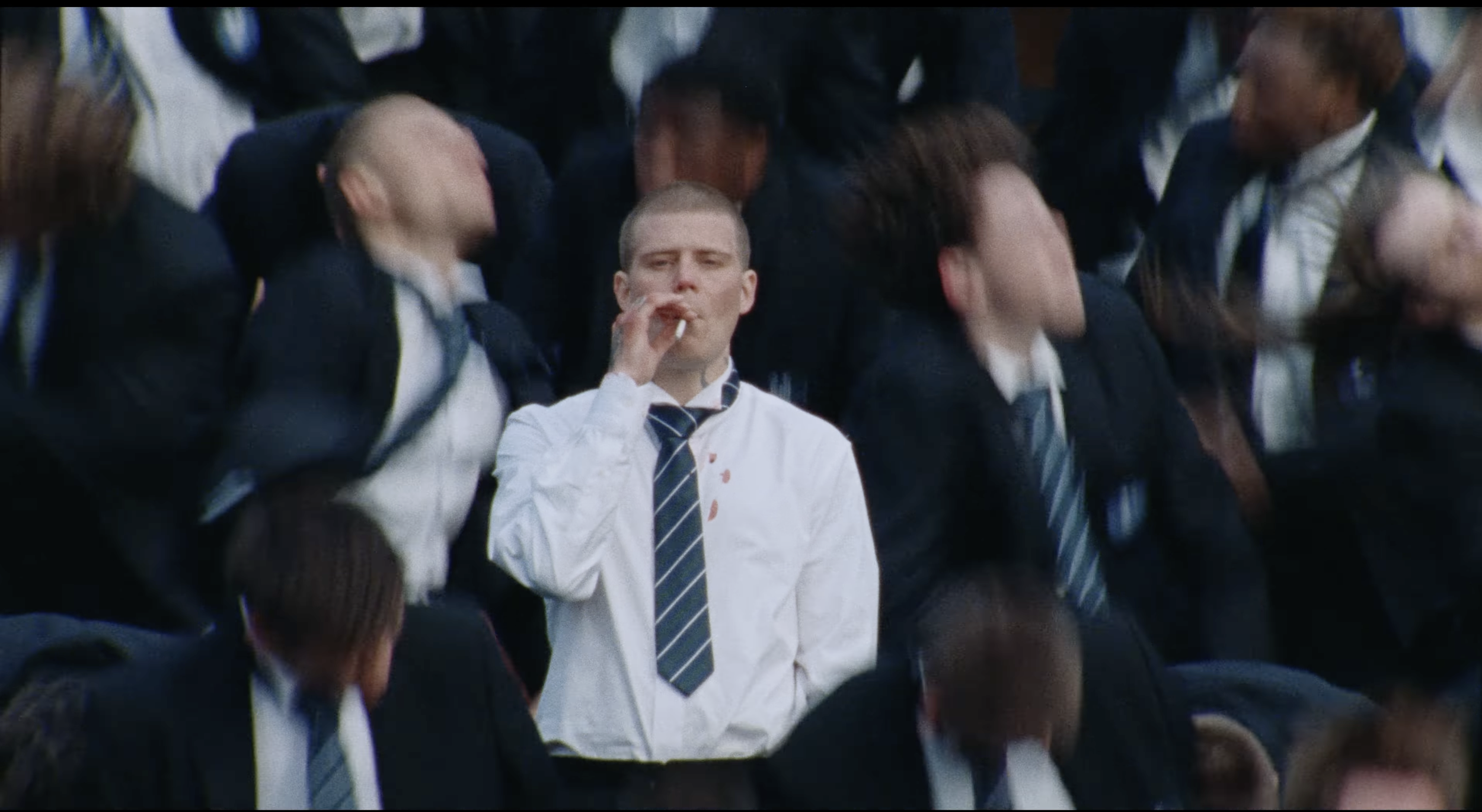
Then Storm, the pièce de résistance and the reason the show ends where it does. Both tracks blended into one cut across two screens, new footage beside the version you know, including a new angle on Damien Jalet's choreography. An all-boys school in Leeds, class of 2034. Normally a place of law and order. The boys are in blazers, lined up for an end-of-term photo, off their heads on lithium stripped out of 6G antennas, the fastest tech going repurposed as the best high available. That detail is the whole project. The drug changes, the impulse doesn't. First half is chaos, second half turns almost euphoric, and what pulls them together is just the dancing. It brings out the most rebellious side of them and unifies them at the same time. Watching it, I felt like I'd stepped back in time and had every teenage desire fulfilled at once. Six and a half minutes, shot on 16mm, punchline at minute four. Conventional wisdom says don't release it.
The woods, the quarry and the school are the same place. All hostile or ordered, all turned into playgrounds by kids who won't be told otherwise. A hollow earth cult, a toxic quarry, a boarding school, same shape every time. Somewhere you shouldn't be, made into somewhere to be together. Which is what Visions of 2034 is actually about. The future can't stop teenagers. It doesn't touch the need to find each other somewhere you're not supposed to be, and doesn't much care whether the thing they organise around makes any sense.
Surkin is blunt about the attention side. Speaking to VF, he said they can't compete with kids making ten-second videos, that they're old now and it isn't in their blood, so they stopped trying and made the thing they're good at instead. Then "Storm" went everywhere anyway. The internet took it, recut it, made it its own, and Gavras calls that part of the conversation rather than a violation, which is the honest read. And it wasn't just reach, it was a different kind of attention. People arguing about the choreography, about whether AI could do this, about what happens at minute four. Real discussion, not a scroll.
Which raises the actual question. Is all attention worth the same? A view is a view as far as any dashboard is concerned, but standing in a dark room letting something run for six minutes is a different act to letting it pass you on a feed. The album is the traditional format, the internet cut is the reach, and the room is where it pays off, because the room reframes music videos as what they always were when someone made them properly. Work worth standing in front of.
It closes on 26 July, so you've got about a week. The internet cut will be there forever. The room won't, and the room is the point.
Listen: Love & Tears
Tickets: 180 Studios
